📋 In This Article
- The snug-not-tight rule explained
- Why trail fit is different from road fit
- The thumb’s width rule (and when it matters)
- Heel lockdown — the most overlooked part
- Toebox width: length isn’t the whole story
- How tight to lace trail shoes
- Should you size up?
- Signs your trail shoes don’t fit
- Frequently asked questions

⚡ Quick Answer
Trail shoes should feel snug, not tight. Your heel should be locked with zero slippage. Your midfoot should feel held firmly. And there should be about a thumb’s width of space between your longest toe and the front of the shoe — always checked while standing up, with your running socks on.
You finally got yourself a pair of trail shoes. You lace them up, walk around the house, and something feels off. Too snug? Too roomy? The toe box feels weird. Your heel moves a little. Now you’re second-guessing everything.
Sound familiar? This is one of the most common questions new trail runners ask — and it matters more than most people think. Getting the fit wrong leads to blisters and cut-short runs — and what you wear hiking matters just as much as the shoe itself It means blisters, black toenails, twisted ankles, and runs cut short before you wanted them to end.
Let’s break it down in plain English.
The Snug-Not-Tight Rule Explained
The golden rule for how tight trail running shoes should be is simple: snug, never tight. Think of a firm handshake — confident and controlled, not crushing.
| Zone | How it should feel | What to watch for |
|---|---|---|
| Toes | Room to wiggle and splay | ~1 thumb’s width from end of shoe |
| Midfoot | Firmly held, not squeezed | No pinching across the arch |
| Heel | Locked in — zero slippage | No lift when you raise your heel |
| Overall | Secure but not restrictive | No numbness, tingling, or hot spots |
Why Trail Shoe Fit Is Different From Road Shoe Fit
Most people make the mistake of applying road shoe logic to trail shoes. On roads, a slightly roomy shoe isn’t a huge deal — the surface is predictable and flat. Trail running is a completely different story.
Your foot needs to deal with:
- Uneven, loose, or slippery ground
- Sudden direction changes around roots and rocks
- Long descents where your foot slides forward with every step
- Climbs where your heel needs to stay fully anchored
Because of this, trail shoes are built with a more secure fit than road shoes — stiffer uppers, more aggressive midfoot lockdown, and deeper heel cups. A shoe that fits fine for a road 10K can feel dangerously sloppy on a muddy descent.
The Thumb’s Width Rule — And When It Actually Matters

You’ve heard this before: leave a thumb’s width of space between your longest toe and the front of the shoe. Good advice — but most people check it the wrong way.
⚠️ Common Mistake
Most runners check toe room while sitting in a shoe store. Your foot is shorter when sitting. Always check toe room while standing, fully laced, with your running socks on.
The reason this space matters on trails: when you run downhill — unavoidable on most routes — your foot slides forward with every step. If your toes are already against the front, every descent jams your toenails into the toebox. That’s how you lose nails and end up with bruising that takes weeks to heal.
How much toe room is right?
About 10–12mm — roughly a thumb’s width — is the target. For longer runs or ultramarathon distances, some runners prefer slightly more to account for foot swelling late in the effort.
Heel Lockdown: The Most Overlooked Part of Trail Shoe Fit
Most people focus all their attention on toe room. The heel is where trail shoe fit actually makes or breaks your run.
Your heel must not move. At all.
Even 2–3mm of heel slippage — which feels harmless when you’re walking around a store — creates serious problems over 10 or 20 miles of trail. That micro-movement causes friction (blisters), reduces your power on every climb, and stresses your Achilles tendon with each stride.
How to test heel lockdown properly
Put the shoe on, lace it the way you’d actually run, then try to lift just your heel while keeping your toes pressed to the ground. There should be almost zero movement. If your heel rises noticeably, that shoe is not holding your foot correctly — regardless of what size is on the label.
The heel-lock lacing technique
Some trail runners use a runner’s loop using the top eyelets to create extra ankle hold. It can help when you’re between fits — but it shouldn’t replace a shoe that actually fits your heel from the start.
Toebox Width: Length Is Only Half the Story
Shoe sizing in terms of length is only half the equation. Width matters enormously for trail running.
When you’re navigating technical terrain, your toes naturally want to splay outward to give you balance and grip. A toebox that’s too narrow prevents this. Over distance, that compression causes blisters between the toes, hot spots on the ball of the foot, and longer-term issues like bunions.
A well-fitting trail shoe should allow your toes to spread naturally when you’re standing flat-footed. If your pinky toe is being pushed inward, or your big toe is angling toward the centre, the toebox is too narrow for your foot.
💡 Good to Know
Brands like Altra and Topo Athletic are known for wide toe box shoes, foot-shaped toeboxes. Hoka also offers wider fit options across several models. You don’t have to sacrifice performance to get wide toe box options — many serious trail runners prefer roomier toeboxes for better balance on technical terrain.
How Tight Should You Lace Trail Shoes?
The shoe itself is only part of the equation. How you lace it changes the fit dramatically.
Your laces should be firm across the midfoot but not digging in. The sweet spot is a gradient:
- Slightly looser at the toes — allows natural splay
- Firm through the midfoot — gives control on uneven ground
- Snug at the ankle — holds the heel locked in place
Common lacing mistakes
- Too loose everywhere: Your foot slides around, especially on descents. Blisters follow quickly.
- Too tight everywhere: Restricts blood flow, leads to numbness and tingling. Gets worse as feet swell.
- Tight at toes, loose at midfoot: Creates a pivot point — your foot rocks inside the shoe.
- Loose at toes, tight at arch: Toes jam forward on descents and the arch causes hot spots.
Should You Size Up in Trail Running Shoes?
Yes — in most cases, by about half a size. This advice comes up constantly in trail running communities, and it’s backed by real experience on long runs and descents.
The combination of foot swelling on longer efforts and the forward slide that happens on every descent means your regular shoe size often ends up feeling too small by mile eight or ten. Half a size is the standard recommendation, though some runners go a full size up depending on wide hiking shoes vs standard fit.
📏 Key Balance
Enough space to accommodate swelling and toe slide — but not so much that your foot slides around inside. Loose shoes on trails are a blister machine.
Signs Your Trail Shoes Don’t Fit Right
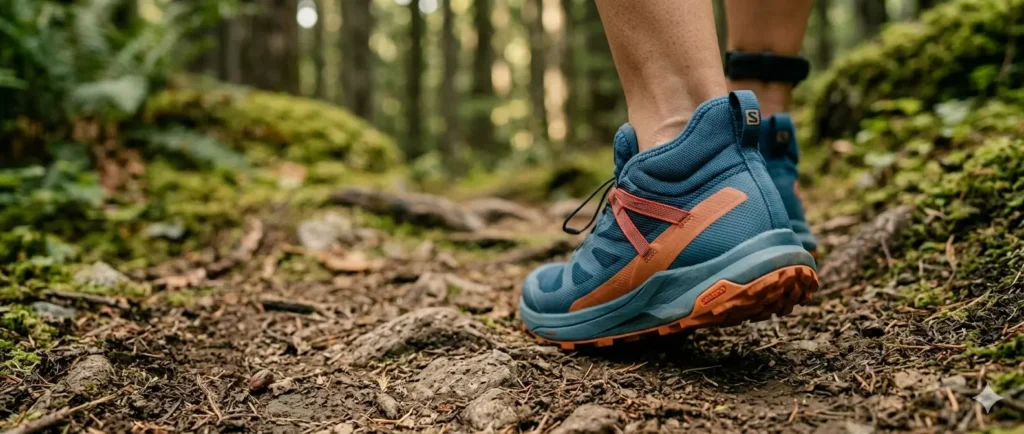
If you’re already running and wondering whether something is off, these are the telltale signs:
- Black or lost toenails — shoe is too short or too narrow in the toebox
- Blisters on the heel — heel is slipping; try heel-lock lacing first
- Blisters on the ball of the foot — toebox too narrow, toes can’t splay
- Numbness or tingling — laces or shoe too tight across the midfoot
- Rolling your ankle more than expected — shoe too loose overall
- Pain on top of your foot — laces too tight, re-lace with less pressure
🚨 Don’t Push Through
None of these symptoms should be accepted as normal. Trail running is already hard on your body. Starting every run with shoes that don’t fit just adds unnecessary injury risk to an already demanding sport.consider switching to lightweight waterproof hiking boots if trail shoes keep causing problems
One more thing worth knowing: your feet genuinely change over time as you log more miles. Regular running strengthens the muscles and tendons in your feet. Your arch may shift. Your foot often widens. The shoe that fit perfectly 18 months ago might not be right today. Do a proper fit check every time you buy new trail shoes — even if you’ve been wearing the same model for years.
Always try shoes with your actual running socks on, and later in the day when your feet are at their largest.
Frequently Asked Questions
How tight should trail shoes be?
Trail shoes should feel snug — not tight. Your heel should be locked with zero slippage, your midfoot held firmly, and there should be about a thumb’s width of space between your longest toe and the front of the shoe. Always check this while standing, not sitting.
Should trail running shoes be tight or loose?
Neither extreme. They should be snug through the heel and midfoot for control, with a bit of room at the toebox to allow toe splay, foot swelling, and forward slide on descents. Loose shoes cause blisters. Too-tight shoes cause numbness and black toenails.
Should I size up in trail running shoes?
Yes — most trail runners recommend going half a size up from your regular shoe size. Your feet swell during runs, especially longer ones, and your foot slides forward on descents. Extra toe room prevents nail bruising and blisters over long distances.
How do I know if my trail shoes are too tight?
Signs your trail shoes are too tight include numbness or tingling in the toes, blisters on the ball of your foot, hot spots on top of your foot, and bruised or black toenails after runs. If any of these appear, try sizing up half a size or choosing a wider model.
How much toe room should trail shoes have?
You should have about a thumb’s width — roughly 10 to 12mm — between your longest toe and the front of the shoe. Always check this while standing up with your running socks on, as your foot lengthens under your body weight compared to when sitting down.